The Game Within The Game
An analysis of an at-bat with Ernie Clement (June 3, 2021)
By James Marvel
(written in the spring of 2025)
_______________________________________________________________________________________________
With baseball season underway, I’ve been thinking a bit about one of my favorite aspects of our beloved pastime: the cat and mouse game between the pitcher and hitter. As the game has continued to evolve over the last few years, the strategic battle between the pitcher and hitter — scouting reports, in-game adjustments, baseball IQ, intimidation, gamesmanship — gets talked about less and less, both within the game and about it.
While the evolutions in the game and why they have occurred could be an essay in and of itself, for the purposes of this piece, it can be summed up simply: pitchers’ stuff and hitters’ ability to do damage have progressed to the point where both of their objectives in each at-bat are more straightforward than ever before. Pitchers want to maximize their stuff — whether on a fastball, breaking ball, or off-speed pitch — to achieve a result of swing and miss. Hitters want to maximize their swing and contact to achieve a result of doing the most damage possible — hopefully a double or home run.
This has diminished the softer skills that have long been a part of the game. For pitchers, this would include reading swings, anticipating hitter adjustments (throughout the game and in individual at-bats), taking historical matchups and results into account, and the ideal goal result of the at-bat — today this is basically only a strikeout, whereas for a long time it may have been a first-pitch groundball or a setup for a later plate appearance. For hitters this would include setting up the pitcher to throw a certain pitch, changing swing-type based on count or objective, and playing mind games with the pitcher — staring him down, or calling for time more than once to try to disrupt rhythm. There are countless more factors that could go into these sections, but for most of the history of baseball, this was known as one thing: the game within the game.
In 2025, if a pitcher can throw 95+mph with an insane amount of induced vertical break, or a sweeper that legitimately looks like a frisbee, what incentivizes him to “read a swing” if it won’t change what he will do next? It certainly isn’t the coaching staff or data analysts, who just tell the players to focus on chasing certain analytical numbers to maximize their stuff. For hitters, if free agents are getting paid based on the amount of homeruns they hit and their “projected batted ball data,” regardless of batting average or other on-field results, there is no incentive to break down your swing in order to try to get on base, or not to strike out as a point of pride. As a result, when we watch the game on TV, most pitchers are throwing two pitches to the same spots over and over, because that’s where the data says those pitches, in a vacuum, perform the best. Most hitters are taking the same swing trying to do damage, regardless of count or situation. When play-by-play announcers and color analysts then talk about the game, much of the discourse is around what the graphics posted on the screen are showing: nasty pitch movement, homerun probabilities, and anything and everything other than what always used to get talked about — the game within the game.
Please don’t misconstrue my observations as criticism. I wish I had a high 90’s fastball with a bastard slider. If I did, I would probably still be pitching today. I feel I’m merely making some statements about the current state of the game.
Because of this, I thought I would share a little bit of commentary of an at-bat from when I was pitching—my thoughts leading up to the game and at-bat, as well as my thoughts during it. Talking about the intricacies from pitch to pitch, and all of the minute details that go into the greatest game on earth, was always one of my greatest joys as a player.
⁂
I’ve chosen an at-bat from June 3, 2021. I can remember with vivid clarity countless at-bats from my career, and this was one of them for a number of reasons, which I’ll get to. But before digging into it, it will be helpful to explain a bit about my game preparation process.
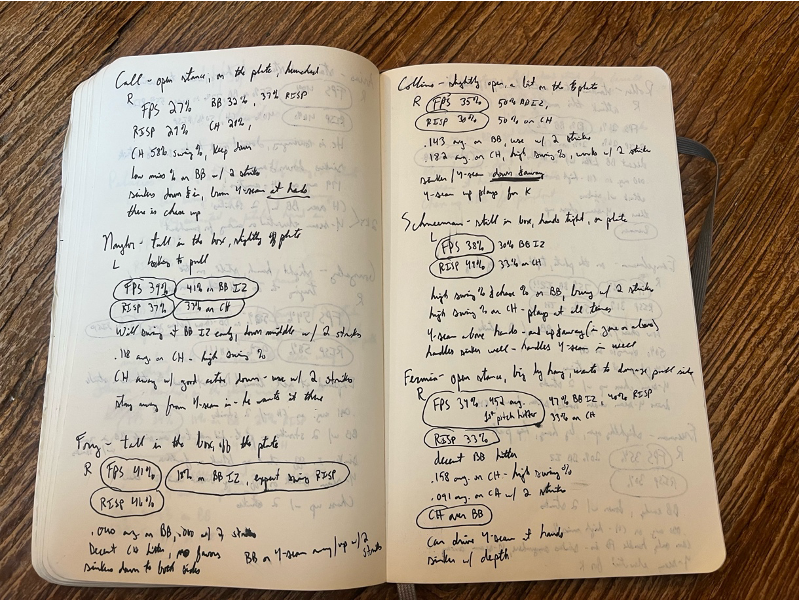
For most of my career I pitched with a fastball at 89-92 mph, and could run it up to 93 or 94 on occasion. By the end of my career, I had 6 different pitches, and I always had to rely on location, changing speeds, reading hitters, preparing scouting reports, and competing incredibly hard — in other words, pitching with balls. Because of my lack of elite stuff, a large part of what I did well was preparing for my starts. I always prided myself on being the most prepared I could be, and aside from all of the physical requirements to be ready to pitch every five days, I felt I really needed to know the hitters I would be competing against. I would take elaborate notes on opposing hitters to compose my own scouting report, which I would use in conjunction with whatever scouting resources the team provided. A page in my notebook might look like this:
In an ideal game schedule situation, I would pitch the third and last game of a series. After Covid, minor league series became 6 games long (MLB series remained 3), so if I was in the minors, hopefully I would pitch at least a few games into the series. This would allow me to get a look at the opposing hitters with my own eyes. While advanced scouting video is readily available, there is nothing like seeing a hitter in person.
The at-bat I will talk about was June 3rd, a Thursday. Because I was in AAA at the time, it was a 6-game series, Tuesday through Sunday (Mondays were off-days). So here is what my preparation schedule would have looked like leading up to that start day on Thursday:
Tuesday (1st Game of Series — 2 Days Before My Start)
We were playing the Columbus Clippers this week, the AAA team of the Cleveland Guardians. Had we already played them earlier in the season, I would have had a lot of notes on the hitters and my process would be slightly different, but because it was our first time seeing them that year (though I had been pitching against many of those guys for the previous few years), my prep process was a blank canvas.
If I could help it, I never liked to do advanced scouting work on hitters before seeing them in person, because as I mentioned before, I preferred my first observations to be with my own eyes. Sometimes this couldn’t be avoided, like if I was pitching the first game of the series, which would force me to do some advanced scouting via video through our internal scouting database. But in the case of this series, things lined up really well.
My process would begin right before first pitch. I would check out the opposing team’s lineup and make note of who was in it that day, and who was sitting. In the minor leagues you see a little bit more lineup rotation than in the Big Leagues as teams are trying to get different players various amounts of playing time. From here, I’d be on the top railing for the first pitch of the game. For the entirety of the opposing team’s first time through the order, I would casually but attentively watch each hitter. Where did they stand in the box? Were they being aggressive? What kind of swings were they taking? Did they have a big bat wiggle while they waited for the pitch? If something caught my attention, I would process it and file it away for later. Hopefully our starter that night was pitching well, and this first time through the order would take 3 innings: 3 up and 3 down for the first 9 hitters. Other times it would take an inning and a third for the opposing team to turn the lineup over. Regardless, as soon as they did, the second part of my process would begin.
As soon as the leadoff hitter was about to make his second plate appearance, I would grab my Moleskine notebook and head inside the clubhouse. On non-pitch days, starting pitchers have the freedom to move about between the dugout and the clubhouse. It was always important to me to be in the dugout as much as possible, supporting both my fellow pitchers and position players. There is no better place to watch the game than from the dugout, and there is no better place to be a good and supportive teammate. However, heading inside the clubhouse at this time was essential to my scouting process. Once inside, I’d plop down on a big couch in front of the television showing the game. I would then watch the game from the same angle that anyone watching at home would be watching. In doing so, I would write the lineup out in my notebook with plenty of room underneath each hitter for notes, and I would begin jotting down anything I remembered from my observations the first time through the order when watching from the dugout, as well as any new observations I had. From this viewing angle I could see minute things that I couldn’t pick up from the lateral view that the dugout offers. Details like how close the hitter was standing to the plate, and how much plate coverage he got with his swing. Was he pulling his front hip? Did he adjust his stance or position in the box relative to the count? What type of pitches, to what location, and with what movement caused him trouble, or vice versa, what was he handling well?
My notes here would all be personal. My opinion on each guy based on what I was seeing with my eyes. By this point I hadn’t looked at any data or stats (other than what is presented during the broadcast) by intention. That point would come later. I wanted my judgements based solely on feel. It was with this feel that I could start to envision how my stuff would play against each guy. Oftentimes the current guy on the mound would feature pitches and stuff that in no way mirrored mine. Perhaps he was a crafty lefty, or a big righty with an even bigger fastball. No matter. This was less about seeing specifically what this pitcher was doing and more about my ability to visualize my own gameplan. The only thing to note here would be if the guy pitching the very day before me was a similar pitcher with similar stuff to me. This was always less than desirable, as when it came time for me to pitch, it would be like the opponent was getting a look at a guy that they had just faced the night before, instilling a level of comfort and familiarity that I would need to account for. If this was the case, then I would have no choice but to closely watch the pitcher’s game plan and subsequent results.
For each half inning that we were on defense, I would go through this process for the entirety of the second time through the lineup. I would return to the dugout for our turn to hit, and then right back inside when we were on defense. Once this second time through the order was complete, I’d put my notebook back in my locker and return to the dugout for the rest of the game. Hopefully the notes I’d taken would start to sink in as I watched the hitter’s third and fourth at-bats, these introductory observations working their way into my subconscious. I would then improve upon them the following day with an even more in-depth process.
Wednesday (2nd Game of Series — 1 Day before My Start)
This day’s process would start long before I arrived at the field. I’d typically wake up fairly early, make my own breakfast if we were at home or find a cool little breakfast spot if we were on the road. Then I’d head to a local coffee shop, arm myself with a 16 oz black coffee, and crack open both my notebook from the night before and my laptop. When I was playing, I used the internal database TruMedia for all of my video and data scouting. There are a number of these databases. TruMedia had everything you could imagine. Every single professional pitch going back to 2008 was logged in here, with video, analytics, and literally anything you wanted to know. If you wanted to know what a hitter’s hot zones were in 2011, in the month of August, during day games, facing a right-handed pitcher, in a 1-0 count, after the 7th inning, you could find that on TruMedia. Suffice to say, if there was something I wanted to know
about a hitter, I could find it.
Every pitcher has different preferences on what they want to know in their scouting report. I’ve played with guys who barely wanted to know anything and would just throw whatever pitch the catcher called without caring why. Others wanted to know a thing or two about the heart-of-the-order hitters.
My favorite pitchers growing up were the artists: Maddux when I was really young, Halladay as I got a little older. Watching them go through a lineup, manipulating hitters, keeping them off balance, guessing, and unable to square anything up, that was always a treat. It was this type of pitching I always tried to emulate, and as I got older and my stuff developed into what it did, I felt I needed to know how to do the same thing to accomplish my goals, which was really one goal with two aims: pitch as deep into the game as I could, and give my team a chance to win. If I was pitching deep into the game, I was probably pitching well and giving my team that chance, and I was helping keep the bullpen fresh as well as my position players involved and in rhythm. This isn’t the main goal of starters anymore (whether by choice or by team imposition), but it was what I built my career on and what I always prided myself in doing. So in creating my scouting report, how to achieve this was always at the forefront of my mind.
⁂
With these preferences, and before digging in too deeply, I want to break down a few details of terminology that, by the end of my career, I came to feel were essential for me to know. I would look into each of these for every single hitter, and note them below the observations I had made the night before. Again, this was my process and what I learned to value over time.
FPS %: First-Pitch Swing Percentage
Simply put, at what rate did the hitter swing at the first pitch? This would help tell me how aggressive the hitter was and indicate how aggressive I could be to the zone. An aggressive hitter doesn’t always mean you are careful with that hitter on the first pitch. Maybe you need to be, but maybe if you throw a good sinking fastball, that is an opportunity for a quick out. If a hitter had a FPS% greater than 35%, that would get circled. Anything over 50% would get an extra circle. By the same token, anything under 20% got circled as well. If over the course of a couple hundred at-bats, a hitter had a FPS% of 11%, there is a great opportunity to establish early count-control by getting to 0-1 without being too fine with your pitch. Strikes are precious, and finding easy ones wherever you can is hugely beneficial.
FPS% w/ RISP (Runners in Scoring Position)
This is at what rate the hitter swings at the first pitch with a runner in scoring position (i.e. on 2nd or 3rd base). With runners in scoring position, it is much easier to bring a run to the plate than it is with nobody on (which would require a homerun) or with a runner on first (which would typically require an extra base hit), often only taking a single or a sacrifice fly. Limiting the amount of runs pitchers give up is in the job description. I found this data point important to know because of these details, but especially so late in a game with the outcome on the line. If I was trying to protect a 1-run lead in the 7th inning with 1 out and a runner on 2nd, my ability to strand that runner there could be the difference in the game. So how aggressive the hitter was going to be in that instance was of paramount importance.
Of special note would be any big differences between FPS% and FPS% w/RISP. Whether or not the hitter became more or less aggressive would tell me something about his mentality (perhaps he really wants to drive that runner in and he gets antsy and anxious, leading him to expand the strike zone).
For example, here is Francisco Lindor (2024 NL MVP runner-up) in 2025. One chart shows his FPS% (against all pitchers), and the other shows his FPS% w/ RISP:

A FPS% of 22.1% means he’ll swing at about 1 first pitch per game (assuming 4 at-bats), and I would consider that being a fairly patient hitter early in the count.
However, his FPS% w/ RISP is almost double the percentage, which is a significant shift in approach for him.
With this, it would lead me to ask a question: why does he do this and how does it present in the game?
Since I don’t know Francisco personally and can’t ask him about it, the why might be hard to determine. However, learning how it presents in the game, like if he chases more pitches out of the zone, I can certainly find out. So while he might not swing at a first-pitch curveball in the dirt with nobody on, with a runner on 2nd, he might do so, which is really useful for me to know. More on learning about that in a bit.
FPS% on Curveball
I didn’t develop a slider until later in my career. I largely pitched with a 2-seam fastball, 4-seam fastball, curveball, and changeup. Because my curveball had a pretty big shape and didn’t quite tunnel with my other pitches as well as a slider does, it was typically a little easier for the hitter to pick up visually when I threw it for a strike (I needed to start it higher, sometimes leading to a little “pop” out of the hand). With this, I wanted to know if the hitter would swing on the first pitch if I just flipped a curveball in there to try to get an early take strike. It was harder for me to throw a really sharp curveball in the zone instead of below it or bouncing. Again, I was looking for “free” strikes, and maybe I could find one here.
If I was a different kind of pitcher, the next thing I might look for is how I could strike the hitter out. But because I was largely trying to get quick outs, preferably weak groundballs, and pitch deep into the game, I wanted to know where I could find a hitter’s weakness for those quick outs.
Hitter Result Weakness
Filtered by pitch type, I would browse Avg. and Slg.% against certain pitches. It is common today, and for good reason, to look at more advanced stats, like xAVG (a hitter’s expected average based on exit velocity and launch angle), xISO (a hitter’s expected ISO based on exit velocity and launch angle), or Hit95% (the percentage of hit balls that are hit 95 mph or higher). There are valid reasons to look at these, but in my opinion, “expected” numbers treated results as if they happened in a vacuum, or the hitter’s ability to hit my specific pitches as if it was happening in the same vacuum. But the result of our at-bat would be determined by human elements in the moment, each of us adjusting to the other, me affecting his perception and mentality with the way I pitch him, and so much more. So while “expected numbers” have their place (and I liked looking at xSLG for heat maps), for this part of my process I preferred the more traditional stats.
I would try to find anything that stuck out. If a guy was batting .120 on changeups/splitters, and has a big enough sample size where this clearly was an issue for him, given that my changeup was one of my best pitches and I could throw it in any count, I felt pretty good that this was somewhere I could go. On the flip side, if a hitter had a high Slg.% on breaking balls and then I saw the majority of his homeruns came on this pitch, I wouldn’t necessarily completely stay away from it, but if deciding between what to throw, this knowledge could be really helpful.
Pitch-Specific Swings and Contact
The second to last thing I looked at were important swing and swing result percentages.
Swing %: per pitch thrown, how often does the hitter swing?
Miss %: per pitch thrown, how often does the hitter swing and miss?
Chase %: per pitch thrown, how often does the hitter swing on a pitch that is outside of the defined strike zone?
Just like the section before, I would just let my eyes softly wash over the numbers, waiting for anything to stick out at me. High swing % paired with a high miss % tells me one thing, where high swing % paired with a low miss % tells me another. There might be one story with fastballs, and another with changeups. Hitter aggression can reveal itself further here, as can patience, or it might be an inability to “see” certain pitches well. I might filter by important counts, like 0-0, or especially hitter’s counts, such as 1-0, 2-0, and 2-1.
To illustrate looking more in depth into counts, take a look at the 1-1 count here. This is for all MLB hitters in the entirety of the 2024 season:

There are some drastic differences between outcomes in a 2-1 count compared to a 1-2 count. If I am trying to maximize every pitch I throw, if I’m in a 1-1 count against Fernando Tatis Jr., I absolutely need to know where I can go in my arsenal to help get him out. The difference between being in a count against him that is 2-1 vs. 1-2 could be a massive turning point in the game. In baseball, things so often come down to one pitch.
Speaking of Tatis, we’ll use him as a further example. As of my writing this on 4/28/25, about 1 month into the season, he is one of the best hitters in the game right now and doing some of the most damage. He’s among the league leaders in average, SLG, OPS, and homeruns, and he’s not striking out that much (only 17 punch outs in 27 games). If I was going to attack him without elite stuff, where do I go? Below is a snapshot of pitch-specific info on the percentages we have been talking about against right-handed pitchers this season:

These numbers are in any count, and the sample size is only 1 month, so they don’t paint a full picture. But you get the general idea. He swings A LOT, doesn’t miss much, and isn’t chasing as much as I would expect. This is just a really good hitter performing at a high level, and sometimes you just have to pitch to your own strengths and go after him. If I was to nitpick, I like what I see on the changeups/splitters, my bread and butter. He’s swinging at 55% of changeups, missing 2/3 of them (including 100% of splitters), and putting them all on the ground when he makes contact. I’ll make note of this and filter by counts to see what else I can dig up on that pitch.
Changeup may very well be a good pitch to throw 0-0, but I also want another option. Tatis hammers breaking balls, especially ones in-zone, so throwing a get-me-over curveball to try to steal strike 1 isn’t the best plan.
When we look at 2-seam/sinkers, my main fastball and a great early count and groundball pitch for me, an initial gauge doesn’t reveal too much:

However, if I filter the count to 0-0, something changes:

(*IZ in these charts just means In-Zone)
Look at how that Chase % has drastically gone up. That is a significant difference, and points to how aggressive Tatis is on fastballs early in the count. He is going after them often and with big swings, and that large Chase % increase tells me his eyes get big when he recognizes heater out of the hand, even if it is out of the zone. I’ll click on that to watch the video of those swings and see where the pitches are and what they’re doing. I anticipate this will be even more of the case against me because Tatis would have gotten a scouting report on me as well. In the pregame meeting, his hitting coach would tell him I’m a guy who doesn’t have a ton of velocity on his fastball, but who likes to throw a lot of strikes and try to get quick outs.
With this, the beginnings of a plan start to develop. In his first at-bat, I may try to throw a sinker that starts on the inner third and runs 8 inches inside. Hopefully Tatis will recognize heater and want to put it in the left field bleachers, start his swing, and by the time he realizes it is burying too far inside to do damage with, he’s swinging over the top of it or beating into the ground to my third baseman. If he takes it, now I’m 1-0 but still feel I’m in an advantage count because of my comfort level throwing a changeup and knowing his struggles with that pitch. And on and on I’ll keep exploring until I figure out multiple plans to him.
2 Strikes
Lastly, I have to know where I’m going to go with 2-strikes. Despite not being a strikeout pitcher, it was in my best interest to punch guys out if I had the chance, and especially if I got to two quick strikes, like 0-2 or 1-2. If a hitter does an ass-out, one-handed swing to put a curveball in the dirt into play, getting a 2-strike out that way was fine with me. But especially in important moments of the game, or that late-inning, game-defining at-bat with runners on, if I could find swing and miss because of a certain pitch or how I set the hitter up throughout the at-bat, I needed to take advantage.
I would use a lot of the same stuff we just talked about, filtered by 2-strikes. I’d go through breaking balls, changeups, and maybe some high 4-seam fastballs (seeing if there is chase above the zone).
Here’s Corbin Carroll so far in 2025 year against righties when hitting with 2-strikes:

You can see how he swings at a pretty high rate across all pitch types, but notice how on breaking balls, his miss% and chase% are much higher. With a soft hypothesis of throwing breaking ball in these 2-strike instances, I would then go watch the video of all those pitches and see what the pitches look like that he’s swinging at, and where they are located. The video might match the numbers, or they might tell a different story.
⁂
There’s one thing to note on looking at video in all of these instances. While it is helpful to see the pitches that make up these numbers, you need to take them with a grain of salt. In my case, most guys throw harder than me, and didn’t have as many pitches or pitch in a similar manner to me. If you include relief pitchers in the data sets for what you are looking through (which I did for sample sizes), then you’re also looking at guys there that have two pitches they are probably using, pitching only one or two innings, and have a different job to do than I did as a starter. The hitter’s plan against those guys is also much different. These differences mean I can’t do the exact same thing they do. It is helpful to take into account, but not the end all be all of attack.
And one note on timeframe. For percentages to matter, sample sizes are key. Towards the end of a season, if a guy has been healthy most of the year, you can just look at that season. Like the Tatis information I’ve discussed, it has only been a little over a month of the season, so it might be important to look at some data from the previous year. In doing so, you need to understand that guys spend entire off-seasons making adjustments, changes to their bodies, their swings, and their approaches, and they may be a different hitter because of it. At the same time, even if at the end of a season, a full year’s statistics and percentages might not tell a full story. As an example, you might be playing a team in August and see a guy hitting .235 with 12 homeruns. However, if you only look at the last 3 weeks, he might be hitting .370 with 8 homeruns. That means that hitter is an entirely different hitter when you will be facing him than he has been for the majority of the season. Oftentimes, what a hitter is doing lately is more important than what he has done in totality (for scouting purposes).
⁂
This process at the coffee shop on Wednesday would take about 3 hours to go through, and I would usually write-up about 10-12 hitters — 9 guys that I thought would be in the starting lineup, and a couple extras who might be in there, or might come off the bench to pinch hit. It was important to me to feel like I knew each hitter and I wasn’t pitching blindly. As a side note, I also felt like this was a reason that I often struggled in Spring Training. I couldn’t utilize one of my greatest strengths in my scouting preparation, because we often didn’t know the opposing team’s lineup until right before gametime. Oftentimes I wouldn’t know who a hitter was when I was facing him. Especially if you were facing a bunch of minor league guys you didn’t know, while other guys could just throw their high-velocity heaters and nasty breaking stuff regardless of hitter, I felt like I was pitching without an essential weapon — my preparation — in my arsenal.
With all of this in mind, my preparation and scouting reports I drew up were tentative game plans for how I would attack a team and its hitters. However, the game and the hitters themselves would dictate the adjustments I would need to make and how quickly. I can take note of a team’s passive first-pitch swing %, but if the first 3 hitters start the game and all swing at the first pitch, there is clearly some type of plan against me that I need to account for. If I note that a middle-of-the-order hitter almost never swings at in-zone breaking balls first pitch, and on a first-pitch breaking he swings and takes me deep, again, I need to be able to adjust. I am happy to put in all of my prep work only to abandon it immediately in the heat of battle depending on what the game is telling me.
Thursday (3rd Game of Series — My Start Day)
So finally getting back to the at-bat that was the impetus for this essay.
June 3, 2021. I was in AAA for the Pittsburgh Pirates, playing for the Indianapolis Indians. We were playing the AAA affiliate for the Cleveland Guardians, the Columbus Clippers. At the end of the 2019 season I had been a September callup (back when they still had those) for the Pittsburgh Pirates, and had made four starts — two good, two bad. I went to Spring Training in 2020 trying to impress a new coaching staff and make the team, but Covid happened and I got hurt at our alternate training site. In 2021, I was assigned to AAA to start the season. The game against Columbus was my 5th start of said season. My first 3 starts of the 2021 campaign were decent, and my 4th not great, as I didn’t make it through 4 innings and gave up 4 runs. Not completely terrible, but 3 decent outings and a bad short one weren’t helping me make a case for a spot in the Big League rotation. It was still early in the season, but for non-prospects like myself and a guy trying to earn a spot in the MLB, there’s not a lot of time. Every start and every time you take the ball is an audition for the front office and MLB coaching staff to determine if you can help them win. I built my career out of not focusing on things out of my control (of which those types of decisions were certainly out of my control), but I was certainly aware of the context in which I would be taking the ball during this start.
Game Time
In the outing, I had two quick first innings — 6 up, 6 down.
And then the 3rd inning went like this:
-I hit the 7-hole hitter on the hands on the first pitch (though I felt like he was halfway done with his swing and had his hands out over the plate).
-I balked and he got to second.
-The 8-hole hitter hit a hard single that scored a run.
-The 9-hole hitter hit a hard single that made the situation 1st and 3rd with no outs and the top of the lineup up.
Here is where the inning can get away from me. I’ve already given up a run, and 1st and 3rd with no outs and the top of the lineup up is not a fun place to be. I’ve also thrown 16 pitches in this inning already, and in the minor leagues at this time, it was pretty typical to only be allowed to throw around 30 pitches in an inning before you got taken out (to protect player’s health). So I have to find a way to get some very quick outs without giving up too much more damage, and I was going to fight to do everything I can to find a way to do it. Another bad outing on top of a bad outing on top of just okay ones before that won’t help me get back to the Big Leagues. But I can’t worry about any of that now, I have a job to do, and I need to bear down in the present moment and compete.
This is the at-bat that I have been building up to discussing. Up walks Ernie Clement, their leadoff hitter, great contact hitter, and current Big Leaguer for the Blue Jays (he almost hit a walk-off homerun in Game 7 of the World Series in 2025).
In his first at-bat of the game against me, I had challenged him with sinkers, and he rolled over a sinker down and away for a weak groundball.
To orient us: What are my goals here? Given that I was a groundball pitcher, if I could get a quick double play, I would be willing to trade a run for 2 outs, putting me in a position to get my hitters back in the dugout without having given up much damage and an opportunity to reset.
Here’s what I would’ve known about Clement, and here are the notes I had on him:

This was his xSLG and hit chart for the first month of the season before this game. Small sample size, but this shows me he’s willing to hit the ball to all parts of the field. To broaden this sample size a bit, I had looked into these same charts for all of the 2019 season as well (he didn’t play during 2020 because of Covid):

This confirmed for me that he could take the ball to all parts of the ballpark, likely with where the pitch was thrown, taking what the pitcher gave him. Not a ton of SLG, mostly cold except down and in. Coincidentally, the only spot that he seems to do a little damage with is down and in, which is where traditionally I would’ve wanted to throw him a sinker for a quick double play. Given that I threw him 3 sinkers in his first at-bat, I needed to take this into account. He also only had 3 total homeruns in his 3 professional seasons before this. So a contact hitter, and probably a smart hitter (Virginia for college).
Here's what my notes on him said:
Clement: Righty
-standard stance, slightly hunched; a bit on the dish
-FPS %: 37%
-FPS % on BB (breaking ball): 32% — not afraid to swing
-FPS % w/ RISP: 25%
Here were his traditional stats filtered by pitch type:

Not a ton to note here for traditional stats on certain pitches, other than I wish I had a cutter (it wasn’t until a few years later that I developed one).
So I would want to know what kind of action happens when he swings:

My notes on these additional pieces of information:
-Extremely low miss % on all pitches, as well as pitches with 2-strikes. Swings a lot; surprisingly chases out of zone a bit, but also finds a way to make contact
-Doesn’t miss breaking ball or changeup much (15% and 6%)
-Beat with good fastballs, don’t try to force strikeout
I know all of this as Clement steps into the box.
1st & 3rd, No Outs
Let's watch these videos to see how it plays out.
Count: 0-0
I go with a curveball here, thinking that he is looking to be aggressive against a heater. My hope was to throw a good one in the zone, and when he recognized spin, he’d take it for a strike, and at the worst, roll over it. He swings, and to me the swing indicated that he wasn’t looking for that pitch, but decided he wanted to pull the trigger. That he swung and missed indicates this too, as it wasn’t the best curveball, hanging up there a little bit, and I got away with one.
Count: 0-1
His willingness to swing at an 0-0 curveball showed me he’s factoring the situation into his plan. In an important situation like this, lots of pitchers will go to their offspeed stuff, and now that I am ahead 0-1, I figure he is expecting me even more to come back with something offspeed, probably in a better location than the 0-0 pitch. To me, this is a great opportunity to go hard in on his hands, because as we recall, I’m still looking to trade 2 outs for 1 run, and a hard sinker that gets in on him can get me just that. Especially considering that he puts the ball on the ground at a 56% clip against this particular pitch.
This is what I do, starting a sinker on the inside black and running it right into his hands, a good foot or so off the plate. His little check swing where the pitch almost hits his hands, showed me he was definitely looking softer out over the dish, and because it ran hard in more than it sank, it tunneled a little bit better with the previous curveball, making pitch recognition harder. This is a great outcome for this 0-1 pitch, as I’m expecting he now really has no idea what I’ll come at him with, and we are now ahead 0-2.
Count: 0-2 (1st 0-2 pitch in this at-bat)
This is where things get interesting. I'll pull Clement's 2-strike chart back up again:

This chart sums up why I made the note not to try to force a strikeout. The season before this at-bat (2019), Clement only struck out 34 times in 405 at-bats, which is a strikeout rate of just over 8%. For reference, the average strikeout rate in the MLB in 2025 is 21%. In a vacuum, Clement would probably strikeout at even lower percentages against my pitches, because I don’t throw as hard or have as nasty of offspeed stuff as what makes up the majority of these percentages.
For this count, it might make sense to throw a curveball again, but this time in the dirt. Clement’s highest miss% is on that pitch. However, this is where the game within the game comes into play. I think he’s probably expecting me to do that, and he’s already seen a curveball in this at-bat. It’s also an easier pitch to flip into the outfield through the air, which might score a run and not get me my coveted 2 outs.
I go with the changeup because changeups are a fairly high swing and miss pitch for me, especially right-handed pitcher on right-handed hitter when they are executed well. I don’t think he’s expecting it, and it’s a good groundball pitch if he makes contact.
I throw one with some decent action, though it catches a little bit too much of the zone for my liking. If it could have started at the bottom of the zone and then dropped on top of the plate, that would have been better. Because of the slightly below-average location of this pitch in an 0-2 count, the movement, velocity, and location difference from the previous pitch is what leads to him fouling it off instead of doing some damage with it.
Count: 0-2 (2nd 0-2 pitch in this at-bat)
I didn’t have any specific rules for myself when deciding pitches, but I usually didn’t like to throw curveballs after changeups. Changeups slow the hitter down, making his timing and ability to stay on a breaking ball immediately afterwards a less than ideal pitch selection.
I go with another changeup, and force myself to get this one down below and out of the zone, but he fouls it off once again. I do this despite his 6% miss rate on changeups, 1) because I believe in my stuff and how I’ve set him up this plate appearance, 2) I don’t think it’s a pitch he can comfortably sit on, and 3) I can still get a groundball. With the foul tip, he’s proving what we knew about his hands and ability to control the barrel and get to baseballs.
We are in a full-on battle.
Count: 0-2 (3rd 0-2 pitch in this at-bat)
What do I do now? Clement has shown his great hand-eye ability. He’s fouled off 4 straight pitches (though the fastball inside on the second pitch really beat him). It’s unlikely he’s going to swing and miss at my lower-velocity fastball, my curveball, or my changeup, with miss%’s of 9%, 18%, and 6%, respectively. I can’t give in to him, especially in this count, and hope that things work out.
Without a clear idea of what to do, something occurs to me that you don’t typically plan for: I can use his greatest skill (his ability to get the bat to the ball) against him. Where have I set up his eyes to be with the last couple of pitches? Down. And though he might not swing and miss at my fastball, a perfectly executed one to the right location will get him to swing, and he will make contact — though not the contact he wants. I hypothesize that if I throw a 4-seam fastball at the top of the zone, because his eyes are set up towards the bottom of the zone, I think he’ll still make contact, but it will be above the barrel — resulting in a pop up.
I execute my pitch perfectly, and an infield pop-up is exactly what happens.
I then get the next hitter, a lefty, to ground into an inning-ending doubleplay, and I escape the inning having given up only one run. I can now reset, and go back out there, and continue to try to pitch deep into the game. I end up going five innings and giving up three runs. Still not great, but respectable, and an outing that gives my team a chance to win.
The final result of my outing is specifically because of the at-bat against Clement, and my success in that at-bat is due to my scouting report. Had I not done the deep dive that I did, things could’ve resulted very differently, like giving up a crooked number and not getting out of the inning, leaving my team and bullpen behind the 8-ball.
My preparation allowed me to react in the moment to the flow of the game, the situations presented, and minute reads on hitters to react and compete to the best of my ability.
⁂
I have written this from my own side of the rubber, but a mirror image exists in the batter's box. Clement, on June 3, 2021, was almost certainly doing his own version of this work — studying me on video, taking notes (physically, like me; or in his mind) on my tendencies, building a plan for what to look for in each count, adjusting in real time. The at-bat we just walked through was two minds competing as much as it was two bodies. That is what the game has always been at its best.
The version of pitching and hitting I have been describing is becoming more and more rare. And it is not disappearing on its own — it is being trained out of young players, and earlier and earlier in their lives. The focus has shifted from high-level, situation-aware thinking to strictly metric-based action: throw harder, spin more, hit it farther. Those are real skills, and they win games. But a young player who arrives at the upper levels with a beautiful arm or a beautiful swing and no idea what to do with the human being on the other side of the ball will eventually find that the metric-based actions are not enough. And even more dangerous is if we are training the high-level baseball IQ and foundational awareness of the game out of kids at the youth levels. This is what is happening for 8-18-year-old players.
The Clement at-bat was won not by stuff but by the willingness to study, to observe, to think, and to adjust. So was Clement's preparation to face me. Going into the dugout and discussing it with my catcher and my pitching coach. Clement breaking me down to his teammate on the top rail, relaying what he saw and what it means. Doing this analysis every inning of every game. It is what I miss most about the game. Developing these skills is what I most want for the players coming up behind me.
It is one of the reasons I built Marvel Mentorship & Advisory.
This is the game within the game. And it is the best part of baseball.

If any of this resonated with you or if you'd like to share your thoughts, I'd love to hear from you.
Send me an email at: james@marvelmentorship.com

