The Real “About Me” Story
What a life in baseball taught me about the journey — and why I’m passing it on.
By James Marvel
If you haven’t read my brief bio yet, take a quick second to start there. It’ll give you the context for what I’m about to share. The bullet points, the career highlights, the clean arc from high school to Duke to the minors to the Major Leagues to Japan. And all of that is true. But bios have a way of making things look inevitable — like the story only ever moved in one direction. The real version is messier, harder, and more interesting than that. And if you’re a young athlete, parent of a young athlete, coach, mentor, or just someone interested, it’s likely the story that’s more applicable to you. It’s the experiences and challenges between the highlights in a bio that shape us. Left unsaid, it can look like they never happened. This is where the work I do with Marvel Mentorship & Advisory lives.
Early Years
I lived in a few different places growing up, but midway through sixth grade, we moved from Connecticut to Moraga, California — a town tucked into the hills east of San Francisco. My mom had been a standout golfer, winning the Minnesota State Amateur at just 14, later capturing a Big Ten title at the University of Minnesota, and going on to win the prestigious 1979 North & South Amateur at Pinehurst. She also competed in multiple U.S. Opens as an amateur and had a brief professional career before transitioning into sports communications, working with organizations like the LPGA, the Golden State Warriors, and others. My dad built a successful career as a sports journalist, columnist, and executive, with key roles at ESPN, Golf Digest, NFL Media, and other entities. Suffice it to say, sports were a central part of our household.
In 8th grade, while I was playing shortstop for my travel baseball team, I was covering a steal and an opposing player slid into me, significantly breaking my leg. We were more than two and a half hours from home, and in trying to decide what to do, my parents called my pitching coach. That call set off a chain of action — my parents called my pitching coach, who called a pediatric sports medicine doctor, who called a surgeon — and we found out the best place to go. During surgery, the doctor struggled to set my leg correctly and came out to speak with my parents. My mom told him, “I know he’s only 14 years old, but I think he’s going to be a good athlete. Please do everything you can to help his leg get back to as normal as possible.” He returned and finished the surgery as best he could, and two weeks later we found a top pediatric orthopedist who performed a second surgery that led to a full recovery. Without my trusted pitching coach knowing the right people — and without my mom advocating for me in that moment — this story very well could have ended with this paragraph.
For the timeframe between that broken leg and the end of high school, here’s what happened:
I had a major decision to make between staying with the elite travel ball team I was on or switching to one that was more development and relationship focused. I chose the latter.
During the fall of my junior year, I developed two stress fractures in my back that required me to wear a back brace for 23 hours a day for four months, forcing me to miss my football season and conceal the injury from college baseball coaches on recruiting calls (not recommended!) during peak recruiting season.
I worked hard in the classroom to position myself for recruitment by a wide range of colleges. I was proactive in communicating with coaches and was ultimately recruited by more than 30 high-level programs and viewed as a potential high-round draft pick. Throughout the process, I learned how to effectively communicate and correspond with coaches and scouts, all while balancing the demands of academics and baseball. As rewarding as it was to be considered for opportunities I had worked hard for, it was a busy, challenging, and stressful time.
I had an agonizing six-month period of deciding between committing to play at Duke or Stanford (my original dream school), eventually choosing Duke (to be a two-way player). The Stanford recruiting coordinator at the time berated me for my decision and told me I was making the biggest mistake of my life.
I turned down a $1,000,000 draft bonus at the end of the 1st Round to uphold my commitment to Duke. I wanted to get a world-class education, play in a great baseball conference, and have a fun college experience. Plus, if I was a late 1st Rounder and worth $1,000,000 at 18, in three years, imagine where I could get taken and what my signing bonus could be! (spoiler: things don’t go according to plan).
I still got drafted in a late round by the Minnesota Twins, back when teams would draft young promising players at the end of the draft while knowing they wouldn’t sign, in the hopes of developing some good will for the future.
By the end of my senior year at Campolindo High School, baseball had become my whole world. I pitched, I hit, I lived for it. I was fortunate enough to have had some success and to be named NorCal Player of the Year, with seemingly endless opportunities in front of me. My parents were wonderfully supportive, and their love, sacrifice, and endless dedication to helping me succeed built the foundation for my entire career, and life. And the mentors I had during this stage — my pitching coach, Jeff Pick; my high school coach, Max Luckhurst; my travel ball coach, Jon Zuber; younger travel ball coaches, Clint Hoover and Brock Griffin — instilled in me tremendous confidence and self-belief by investing in me, believing in me, and offering more than just a coaching relationship. They became mentors, guides, and friends. And still are to this day.
More Decisions and The Injury That Changed Everything
Two weeks before I set foot on Duke’s campus, the entire coaching staff got fired. I had spent so long on my college decision, and this was a major gut punch. All of a sudden, there were significant questions: Who would the new coach be? Would he honor my scholarship? Should I open my recruiting back up and consider the other schools I had been looking at? Or was I too late now in the process? What type of loyalty did I owe Duke and the other incoming baseball players? Keep in mind this was before the transfer portal and NIL.
The decision of what to do was the biggest I had ever had to make in my young life at the time, and it was the beginning for me of understanding decision frameworks, downstream consequences, and the moral and practical weight of my choices in ways I had never had to before.
I upheld my commitment to Duke and went early to attend summer school. With the hopes of getting drafted after my junior year, I was trying to get ahead in my academics and get used to campus life with a few new teammates.
With the nervousness of starting college and the sadness of leaving my family and friends, I was beyond excited to be on my own and start my college life.
During summer school, two weeks after arriving at college, I met the woman who would become my future wife. She was starting school early too, as a member of the Duke women’s volleyball team. We started dating soon after and have been together ever since.
I learned to balance an incredibly demanding academic schedule with an equally demanding baseball schedule.
In the fall, I began to develop significant leg pain (the same leg I described breaking at the outset of this essay) that the Duke training staff had trouble diagnosing. I spent October to May in a walking boot and would take it off only to pitch (this would never happen now).
I earned a starting pitching job, and pitched fairly well, but because of my leg issue, too much stress started going to my arm, and I developed bad elbow pain. I missed more than six weeks of my freshman season.
I had some challenges in my relationship with my head coach during this time and for periods afterward. I had never had this with a coach of mine before, and it taught me a lot about communicating with people in authority, especially coaches.
I had another surgery on my leg after my freshman year, had a strong sophomore fall, and pitched great the first four starts of my second season. But the elbow pain returned and I pitched through a torn UCL in my elbow against Virginia, the #1 team in the country at the time, and then needed surgery. My parents and I researched the three best doctors across the country, cold called their offices, and with persistence, got in to see Dr. Neal ElAttrache, the country’s preeminent orthopedic surgeon, who performed my Tommy John/UCL surgery two months later.
I missed the rest of my sophomore season and all of my junior season while rehabbing my elbow. It was a long journey and one of the most defining times of my life. I learned many things, some of which were: how to deal with adversity; how to navigate loneliness while separated from my teammates during rehab; frustration at how far away my dreams felt; how to assess where I was, where I wanted to be, and how to bridge the gap; and finally, that I would do whatever it took to accomplish my dreams. I look back on this time, and though most of my college career got cut short and I had been knocked off the path I had been on, if given the opportunity, I wouldn’t change any of it.
It’s easy to skip past injuries in a bio. One line: “suffered an elbow injury.” Move on to the next chapter. But that one line significantly impacted my life. I went from starting on the mound in the ACC to sitting in a training room, unable to throw, and uncertain what the rest of my career looked like. My sophomore and junior seasons — gone. Ultimately, I ended up not throwing a competitive pitch for two years.
That injury was a defining moment in my life. Though it was painful to have my dreams threatened, I realized I had an opportunity to use the injury as something to make me better. I decided to rededicate myself to my craft and attack my rehab. Not only would I get back to where I had been, but I could come back even stronger. I became incredibly diligent in the training room and the weight room. I went on an educational journey to learn more about health and nutrition. I studied MLB games in new ways, searching for opportunities to learn and develop my baseball knowledge.
That stretch was a long and difficult one. My teammates were out there competing, and I was watching. My identity had been wrapped around being a baseball player, which had been taken away, and I had to determine who I was without the game. There were days I questioned why this was happening to me. Days that I wondered if choosing Duke over the draft had been a mistake.
The injury taught me that recovery isn’t just physical it’s — mental, emotional, and deeply personal. It forced me to grow, made me grittier, and helped me determine what I was willing to do to reach my dreams. But all of this only came with having the right perspective, which I had to be intentional about developing. Instead of thinking, “Why me?” — I embraced the opportunity for growth that was in front of me. I leaned into believing that each moment was exactly as it should be, and when it comes to setbacks, this is where true growth happens, because the obstacle is the way.
Round 36, Pick 1,087
Despite not pitching most of my sophomore year and all of my junior year, the Pittsburgh Pirates drafted me in the 36th Round with pick number 1,087. With over a thousand players chosen before me, it’s a round that doesn’t even exist anymore (there are only 20 now). The 36th round isn’t a golden ticket, and it was where players typically got drafted in order to fill roster spots for lower-level minor league teams so the real prospects had someone to play against. Kind of like the baseball equivalent of someone saying, “We’ll give you a shot, but don’t expect much.” What round a team drafts you in and how big of a signing bonus they give you is important because the more investment they have in you as a player, the more focused teams are on your development and the more opportunities they give you.
The 36th Round was a long way from the 1st Round opportunity I had turned down just three years prior.
Having barely pitched in college due to injury, I was ultimately drafted for three reasons: first, my track record as a highly touted high school prospect (the history angle); second, the reputation I built throughout my career — even through injury — as a strong teammate, leader, and positive clubhouse presence (the character angle); and third, my relationship with the former Duke head coach who recruited me. After getting fired right before I arrived on campus, he became a scout for the Pirates, and we had developed and maintained a strong relationship (the relationship angle, which in the small world of baseball, can be as important as anything).
Like my college decision, I agonized over whether to sign or not. What did I owe Duke and my teammates? I had barely pitched in college and felt like I had unfinished business. There was no guarantee I would come back and pitch well, and though I believed in myself and that I would, what if I got hurt again? If so, would I lose the opportunity and my dream forever?
Ultimately, I signed with the Pirates. And there was one thing I knew: where I was drafted would not determine where I ended up.
The Minors
Minor League Baseball is a world most fans never see. When I started in the summer of 2015, you were seven levels away from the Big Leagues (it’s five levels now). It’s eight- hour bus rides after a night game. It’s salaries that don’t even cover rent (though this has changed in recent years). It’s moving to a new city every season, sometimes mid-season, usually with zero notice. And the competition is relentless — every single guy on the field was the best player in his high school, his college, his town. And that’s just the baseline.
I spent four years climbing through the Pirates’ system: the training complex in Florida; two teams in West Virginia; Bradenton, Florida; Altoona, Pennsylvania; and Indianapolis, Indiana. There were seasons I pitched well and felt the momentum building. There were stretches where I struggled and had to stare down the question every minor leaguer faces eventually: Am I good enough?
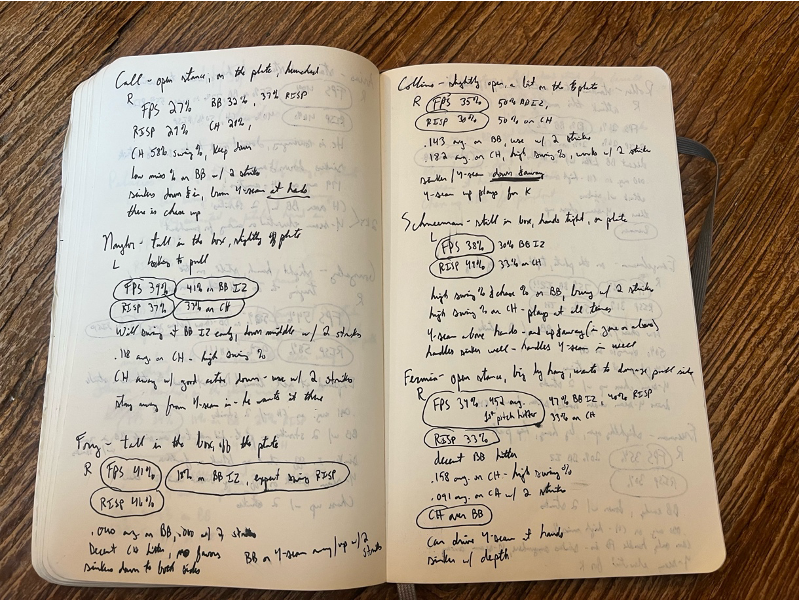
What I kept coming back to was the process. I couldn’t control whether I’d get called up. I couldn’t control whether the organization believed in me. What I could control was how I prepared every single day. So that’s what I did. I studied hitters obsessively. I worked on sequencing and command. I didn’t have a 97-mph fastball (if I did I’d still be playing) — mine sat in the low 90s, which in today’s game is slow by comparison. But I could locate, read hitters, make adjustments, change speeds, and outthink hitters. In other words, I could pitch. And I always competed like hell.
There are lessons in there that I carry with me to this day: you don’t have to be the most gifted person on the field or in the room. But you damn well better be the most prepared.
Some notes on the climb:
Right after getting drafted, I reported to the lowest level of the organization to finish my elbow rehab, and in the facility dorms, slept between two Latin players who stayed up all night watching Spanish soap operas (ear plugs and an eye mask became nightly staples in the minors).
Slowly but surely, I pitched well for a few years but still watched many less-deserving players (based on on-field performance) get promoted ahead of me. Decisions about me weren’t in my control, so I had to double-down on the controllables. Preparation. Discipline. Good decision-making. Growing as a leader and being a good teammate.
Education had always been a priority for me, so during the off-season in the fall of 2017, I returned to Duke to complete my one final semester and earn my degree. The majority of players who leave college early don’t go back to obtain their degree. Because I had taken an accelerated academic schedule — advanced coursework and two summer sessions — I only had one semester left instead of two. Balancing the demands of finishing my degree (and being in class as a 24-year-old) while training for an upcoming professional season was challenging but rewarding, and it remains one of my proudest accomplishments.
In Spring Training of 2018, the Pirates Pitching Coordinator told me I wasn’t going to be a starting pitcher anymore, saying, “We think there are five guys better.” I only got back in the starting rotation because my friend and teammate had a heart condition that led to him missing the season. I felt terrible for him, but this was just one example of the many lucky breaks along the way that are needed on your journey.
Through the years, I had traveled across the country to multiple different training facilities, seeking out the best trainers I could find — ultimately leading me to Eric Cressey, widely regarded as the best in the business. I trained with Eric both in-person in Florida and remotely for six years. When I was away from his facility, including time spent living with my girlfriend, Eric connected me with trainers and coaches at nearby universities who would let me come use their facilities, allowing me to train oftentimes right next to their college athletes. This isn’t standard practice and was always an uncommon opportunity. It is another example of how strong relationships can lead to access within trusted networks. Eric remains a mentor to this day.
2019
Everything I’d been building toward came together in 2019. I won’t list every stat or start, but the short version is I had the best year of my career. I was named a Double-A All-Star. I got promoted to Triple-A and didn’t lose a game. The Pirates named me their Minor League Pitcher of the Year. My 16 wins led all of minor league baseball that season — every league, every level, and I pitched more innings than any other minor league pitcher.
More than any number, what that year proved to me was that the process works. If you are intentional, resilient, gritty, and want it, you may get rewarded. It’s not guaranteed, nothing worth having ever is. But you might. Years of quiet, unglamorous preparation — all those bus rides, all those bullpen sessions nobody saw, all those games where I went out and just did my job — it added up. Not overnight. Not on anyone else’s timeline. But it added up.
And despite all of this, at the end of the season, I still didn’t get called up. After our last game (in which I pitched an excellent five scoreless innings), one by one I watched three teammates of mine get called into the manager’s office and get told they were going to the Big Leagues. I wasn’t one of them. Two hours after I threw my last pitch of the season and then said my goodbyes to teammates and coaches, I got in my car and drove nine hours home, allowing myself to be frustrated for a moment, proud for a little longer, and contemplative about how I would continue to will myself to the Big Leagues.
To continue my never-ending quest to get better, I had scheduled myself to fly across the country to Seattle a few days after our season ended to go to a training facility for an extensive pitching evaluation. I was trying to find any type of marginal gain I could. Because of this, I continued to throw to keep my arm in shape, and I did so against a fence at a tennis court near my apartment (I threw against a fence or wall thousands of times in my career when I didn’t have a throwing partner).
On the night of September 3rd, one of the starting pitchers on the Pirates in the Big Leagues got hit in the wrist with a line drive. He ended up being okay, but out of precaution, the team needed another starting pitcher…
In the game of baseball — a ball that lands on the foul line, an umpire decision going your way, Wally Pipp having a headache — you need a little luck on your side.
The Call
On September 4th, at 11:00 pm, my girlfriend accidentally woke me up when she went to the bathroom, and I rolled over to see that my phone, on silent, was ringing. I was getting a call from my Triple-A manager, Brian Esposito. He asked me where I was and if I could get to Pittsburgh the next day, because I would be starting for the Pirates on Sunday.
My girlfriend was there next to me, and I hugged her tight when he told me. The best way I can describe the feeling is this wave of a sensation traveling through my entire body. Excitement, jubilation, and nervousness all wrapped in one. The physical reaction to being told that your lifelong dream, the dream you’ve worked for, sacrificed for, and lived for, was coming true.
I called my mom and dad.
I called my pitching coach back home. My high school coach. A couple other mentors and coaches who meant the world to me. This was theirs as much as it was mine.
I made my Major League debut on September 8th, 2019, a 1:00 pm game at PNC Park in Pittsburgh, against the St. Louis Cardinals.
I pitched well — into the 6th inning. We ended up losing, but for a kid who’d been drafted in the 36th round, who’d come back from an elbow injury that cost him two years, who’d spent four years riding buses through the minor leagues — standing on a Major League mound was the culmination of a journey and the dream of an 8-year-old boy.
I was incredibly grateful to need 46 tickets that memorable day — family, friends, coaches, mentors, and former high school, college, and minor league teammates all flew to Pittsburgh to cheer me on. It reinforced something I had always known: I never did it alone. Throughout my journey, I was surrounded by constant love, guidance, and unwavering support.
The Part Nobody Talks About
This is where the story stops looking like a movie and starts looking like real life.
Right after the season ended, the front office and coaching staff who called me up, and who knew me and believed in me, all got fired.
Six months after making my Major League debut, the world saw its first global pandemic in 100 years, and the 2020 season was drastically impacted by COVID-19. Just like that, a year of momentum — gone.
Once again, there’s a throughline: there is so much we can’t control. Who are we when things don’t go our way? Are we the people who can face uncertainty head on, with perspective, and forge a path forward?
When baseball returned to normal in 2021, things for me didn’t click the same way. I pitched a full season at Triple-A, and the results were fine but not good enough. I became a free agent for the first time, and wouldn’t you know it, as soon as I was, there was an MLB lockout. Ding ding, again something I couldn’t control.
When the lockout finally ended, I signed with the Philadelphia Phillies and had a terrible two-month start to the season in Triple-A. When I got called into my manager’s office, I was certain I was getting released. Instead, the organization wanted me to pitch out of the bullpen — something I’d never done before — but they were allowing me to decide if I accepted that. I chose to embrace it as another opportunity, another challenge, and a way to continue to learn and get better. Mindset and perspective are vital to success, and this was a chance to prove it. A new skillset might even make me more valuable.
I learned later that the Phillies only gave me that opportunity because the Triple-A coaching staff — specifically my manager, Anthony Contreras, and pitching coach, Cesar Ramos — fought the front office behind the scenes to keep me around. Why? Because I was a good presence in the clubhouse and a good teammate. The outside world will tell you this kind of thing is becoming less and less valuable. It’s not.
After the season with the Phillies, I became a free agent again, but this time didn’t get any offers from affiliated organizations. If I wanted to keep my career alive, I would need to go play in an Independent League, far enough removed from the MLB that people with my pedigree often choose to retire instead of swallowing their pride to keep their dream alive. To me, there was still an opportunity — to compete, to grow, and to earn my way back. I chose to play.
I made ONE start for the Atlantic League’s High Point Rockers and the Rangers signed me. Sometimes it only takes one. Baseball can move fast like that. If somebody sees you on the right day, you can get a chance. You just have to work to be the best version of yourself every time you step on the field, because you never know. I packed up my apartment that night, was on a plane to Reno, Nevada the next morning, and then started the game the following night. That’s professional baseball.
I pitched for the Rangers Triple-A team for six weeks. Some good, some bad. I had to contend with the fact that my stuff wasn’t what it used to be, and though I could still pitch, it was getting harder and harder to get hitters out.
Each of these moves was a fresh reminder that in professional sports, or any level of sport for that matter, nothing is guaranteed and nothing is permanent.
I’d be lying if I said those years were easy. They weren’t. There’s a particular kind of difficulty in knowing what the top of the mountain feels like — you’ve been there, you’ve stood on it — and then finding yourself trying to climb back up from a lower elevation.
It’s especially hard trying to be present when you aren’t reaching your goals and your heart wants to be somewhere else. Balancing that is its own kind of mental challenge.
But every single one of those stops taught me something. My time with the Phillies organization taught me how to be versatile, how to get outside myself and help my younger teammates grow, and to learn to embrace the joy in uncertainty. Independent ball reinvigorated my raw hunger. Down there you’re playing for the love of the game and the slimmest of chances. And my time with the Rangers organization made me confront my future in ways I never had to before.
Each chapter kept asking me the same question it had been asking all along: Who are you when it’s hard? What are you willing to do?
My answer never changed. I kept showing up. I stayed intentional with my work. I honestly assessed myself, strategically developed plans, and got after it. I continued to dream.
Japan
After six weeks in Triple-A with the Rangers, I got a call from my agent: a Japanese team in the Nippon Professional Baseball League was interested in me. The NPB is the second-best baseball league in the world, right behind the MLB. I had previously talked with my agent about the possibility of playing overseas, and it was always an opportunity that genuinely intrigued me. Getting to and staying in the MLB was always my first priority, but as things evolved over my career, Japanese and Korean teams often sought players like me. I’d always loved to travel and was curious about experiencing life in different countries and cultures. In Japan, baseball occupies a place in the culture much like college football in the United States — most games are sold out, and the energy is relentless with fans creating a World Series-like atmosphere every night (drums, chants, and cheerleaders). The teams also compensate their foreign players very well, though money was never the driving force behind my career decisions.
Ultimately, I decided to sign with the Hokkaido Nippon-Ham Fighters (the same team Shohei Ohtani played for in Japan).
In deciding to go play in Japan, what I was also contending with was whether my career in the States was over. There are pathways back to the MLB from playing abroad, but for my particular situation, the opportunity would be slim. I’d been working towards one thing over the past 20 years — to play in the Big Leagues. This decision would mean likely stepping off that track.
My wife had a wonderful job and career of her own and couldn’t move to Japan in the blink of an eye, so going to play in Japan meant leaving her behind — on the exact opposite side of the world. She was accustomed to flying to see me wherever I was playing every few weeks, but this would be a different challenge entirely. From Japan, my days there both started and ended with FaceTimes to her back home. She sacrificed for me throughout my career so I could chase my dreams. Every season, she let me walk out the door for eight straight months, but this time was different. The distance took her sacrifice to another level. We were forced, while also dealing with some separate familial struggles, to love each other, support one another, and grow together in new ways.
In my mind, I framed moving to the other side of the world as the adventure of a lifetime, and it was. But it was also deeply uncomfortable. I didn’t speak the language. The customs were different. The baseball culture was different. If it isn’t clear yet throughout this piece, I am always fighting for more control, and in this instance, I had to really embrace letting go and just accepting the ride. I had to learn to see the game, the world, and myself through a completely new lens.
I pitched well in Japan, and I had a lot of fun. But what I gained went far beyond what showed up in a box score. Living there, competing alongside Japanese players, experiencing a culture that approaches excellence with a patience and discipline I found deeply inspiring — it expanded my understanding of what it means to grow. Growth isn’t just about improving at the thing you already know. Sometimes it’s about dropping yourself into something completely unfamiliar and uncomfortable and trusting that you’ll find your footing.
Retirement
After the season in 2023, I spent four months trying to determine the future of my career, and I ultimately decided to retire from professional baseball. My wife and I were ready to start a family, and I was ready for a new chapter. It was an extremely gut- wrenching, difficult decision, and one I am still grappling with to this day.
When I stepped away from the game, I spent a long time sitting with a question that every athlete faces eventually: Now what? I never had a plan B. To have had one would’ve felt like short-changing myself, as I needed to dedicate every ounce of energy and focus to my goal of becoming a Major Leaguer.
The answer didn’t come all at once. It came in pieces — is still coming in pieces — the same way my career had been built, one day at a time. I started thinking about what baseball had really given me, underneath the surface. Not the stats or the highlights, but the stuff that truly stays with you when the uniform comes off:
That where you start doesn’t define where you end up. I was pick number 1,087. And I stood on a Major League mound. The distance between those two things was closed by daily, unglamorous work.
That adversity is the best teacher you’ll ever have. The various injuries, the lost COVID year, the MLB lockout, the seasons that didn’t go the way I wanted — those chapters taught me more about myself than any win ever did.
That preparation is a superpower. I never had the best stuff on the field. I had the best plan. I was the most competitive. And I wanted it. That’s an edge that translates to everything in life.
That growth lives on the other side of comfort. Moving to Japan at 29 to compete in a foreign country thrilled and scared me. It also pushed me to develop even further as a player and man.
That it’s all about the people along the way. The relationships I built with teammates, coaches, trainers, and front office staff will last a lifetime. I wouldn’t have had this journey without them. They taught me, encouraged me, supported me, laughed with me, cried with me, and always had my back — and I hope I did the same for them. Many stood by my side in my wedding, just as I did in theirs, a reflection of how these connections endured beyond the diamond. I’m deeply grateful for each of them and for the meaningful roles we continue to play in each other’s lives.
That you are more than one thing. Choosing Duke over the draft at 18; balancing the classroom with the diamond; finding passions away from the field along the way; learning to be the best teammate, friend, son, and partner. These were foundational to my success. The people who thrive long-term are the ones who invest in the full picture of who they are.
Why Marvel Mentorship & Advisory
I started this business because the mentors I had throughout my journey changed my life. When I look around at the game of baseball, there are young men out there on their own journeys — fighting for success, learning through failure, finding out who they are. I want to be there for them as someone who can say, “I know what this feels like. Here’s what I learned.”
I work with all kinds of players — entering or within high school; in the middle of college; or already playing professionally — who need someone to help them see that the path is rarely a straight line. I work with student-athletes navigating the challenging balance between competition and academics. I work with families who want the best for their kids and need some clarity and direction.
I’m not going to pretend I have all the answers. I don’t. What I have is a lifetime of experience navigating the highest and lowest points of youth, high school, college, and professional sports; an education from one of the best universities in the world that laid the groundwork for my continued and constant growth; and the perspective that comes from competing across every level of baseball in multiple countries. Most importantly, I believe that the qualities that drive success — growth, resilience, discipline, accountability, curiosity, humility — aren’t ones you’re born with. They’re ones you build.
If any part of this story resonates with you — if you see your own journey in any of these chapters — I’d love to hear from you. I would love to help guide and work with you on your own journey. The best part of my career was never the destination. It was everything I learned on the way there, and who I became because of it.
And now, I get to help someone else become the player and person they want to be.

If any of this resonated with you or if you'd like to share your thoughts, I'd love to hear from you.
Send me an email at: james@marvelmentorship.com